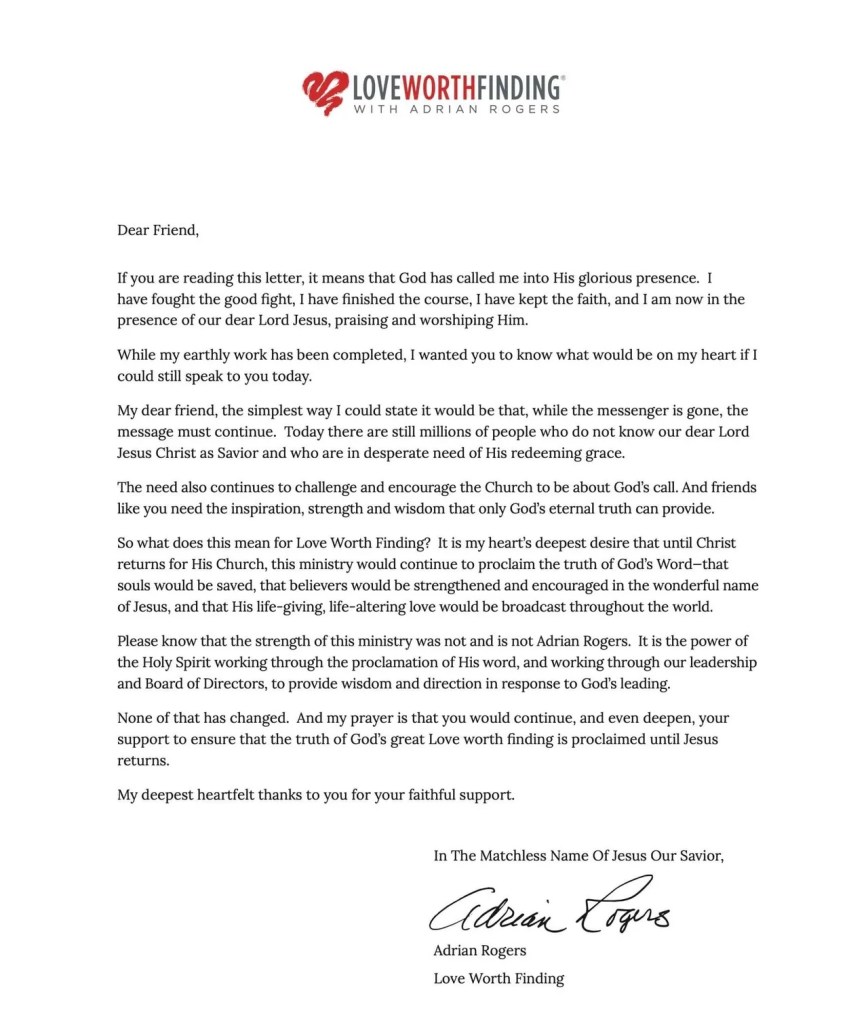
On November 15, 2005, Dr. Adrian Rogers went to spend eternity with our Heavenly Father. While his earthly journey ended, his impact on countless lives continues to resonate. Only God knows the countless hundreds of thousands who have been transformed through his life, teaching, and preaching. Truly, his legacy is one worth celebrating. “Well done, my good and faithful servant.”
Dr. Rogers had a way of seeing the times through the lens of eternity. One of his memorable reflections was, “It is getting gloriously dark, a set-up for the return of Christ.” Today, as the world grows increasingly dark, we give thanks for faithful men like Adrian Rogers who shone as beacons of light, pointing us to Jesus Christ.
In his final months of pastoral ministry, Dr. Rogers closed with a powerful truth: “Heaven is not a reward for the righteous; it’s a gift for the guilty.”These words echo the gospel’s heart, reminding us of the grace and hope we have in Christ.
Let us honor his memory by continuing to carry the light of truth and the love of Christ to a world in need.
In the latter half of the 20th century, the Southern Baptist Convention (SBC), one of America’s largest Protestant denominations, faced an existential crisis. Theological liberalism, marked by a departure from traditional biblical interpretations, began to permeate its seminaries and influence its leaders, sparking a battle over the very soul of the church. At the heart of the storm was Dr. Adrian Rogers, a pastor from Memphis, whose firm leadership and visionary tactics helped steer the denomination back to its foundational beliefs. This blog post explores Rogers’ pivotal role in the Conservative Resurgence, how his strategies revitalized the SBC, and the enduring lessons his story holds for today’s leaders in any field.
A Crisis of Faith
By the 1960s, a wave of liberal theology that questioned the inerrancy of Scripture began to challenge the traditional doctrines held by many within the SBC. This theological shift was not just an esoteric debate among theologians but threatened to fracture the denomination’s unity and dilute its mission. As liberal viewpoints gained traction, they sparked a profound sense of unease among the more conservative members, who feared that the core values of their faith were under siege.
A Leader Emerges
Into this breach stepped Dr. Adrian Rogers, who would become one of the most influential figures in modern Baptist history. Elected as the president of the Southern Baptist Convention in 1979, Rogers was not merely a charismatic leader; he was a strategic one. His first task was to articulate a clear and compelling vision that resonated with the foundational beliefs of the majority of Southern Baptists. He championed the belief in the absolute authority of the Bible, a stance that resonated deeply with grassroots members and clergy alike.
Strategies for Resurgence
Dr. Rogers’ approach to leadership during this period was multifaceted:
Vision Casting: Rogers was adept at using his platform to reinforce the importance of returning to biblical inerrancy. His speeches often reminded his audience of the SBC’s historical commitment to Scripture, framing the Resurgence as a return to tradition rather than a reactionary shift.
Grassroots Mobilization: Understanding the power of numbers, Rogers encouraged widespread participation from the denomination’s base. He urged churches to send delegates to the SBC’s annual meetings, where key decisions were made. This strategy not only democratized the process but also ensured that the voices advocating for a conservative shift were amplified.
• Governance Reforms: Rogers also knew that lasting change required institutional support. He worked to ensure that individuals who shared his commitment to inerrancy were elected or appointed to key positions within the SBC’s boards and agencies. This helped sustain the movement’s momentum and embedded its values more deeply within the denomination’s structure.
Outcomes and Legacy
The Conservative Resurgence fundamentally altered the landscape of the Southern Baptist Convention. It reaffirmed the denomination’s commitment to evangelical principles and ensured that its educational and missionary work remained aligned with its members’ core beliefs. While the movement did lead to tensions and divisions, with some moderates feeling alienated, the resurgence ultimately strengthened the identity and cohesion of the SBC.
Lessons for Today
Dr. Adrian Rogers’ leadership during a pivotal moment in the SBC’s history offers several key lessons for today’s leaders, both within and outside religious contexts:
Clarity of Vision: Effective leadership begins with a clear and compelling vision. Rogers’ ability to articulate a return to foundational values mobilized support and drove significant change.
Inclusive Participation: Engaging the grassroots level can provide the critical support needed to drive and sustain change. Leaders should seek to involve as broad a base as possible to ensure that initiatives have the support and momentum they require.
Structural Integrity: Lasting change often requires reforms at the governance level. By aligning organizational structures with strategic goals, leaders can ensure that their vision is not only implemented but also sustained over the long term.
Conclusion
Dr. Adrian Rogers’ tenure as a leader during the Conservative Resurgence is a testament to the power of principled leadership in navigating challenging times. His story is a reminder that even in the midst of deep divisions and uncertainty, thoughtful, decisive leadership can guide organizations back to their core principles and forward into renewed unity and strength.
 Dr. Jonathan Crawford Blog
Leave a comment