Is the Bible that we hold in our hands today the infallible Word of God? Are the original manuscript infallible? Is the Bible the actual Word of God? These are all questions that people face and today, I hope to bring some clarity to some of these questions.
Many pastors will hold the Bible in the air and say: “The Bible is the inerrant and infallible word of God. When this statement is made they are affirming that the Bible is perfect in every regard. Most of the time, if you pull the pastor aside, he will inform you that it is the original autographs that are inerrant. I do believe this to be true. Of the sixty-six books in the Bible, we do not have a single autograph. In my opinion, they were destroyed along time ago and just do not exist today. However, before you get your pitchforks allow me to qualify this. In 1984, Dr. James Draper was president of the SBC and a copy of his book, Authority: The Critical Issue for Southern Baptists, was mailed to over 37,000 pastors. In it he states: “Biblical inspiration does not mean that the translations or editions or versions are inspired–only the original manuscripts.” Virtually no minister believes that the Bible we hold in our hand is inerrant or infallible.
Let me qualify this further, where my reasoning can be better understood. The Jehovah’s Witness, uses the New World Translation of Holy Scripture. From the www.jw.org website, this Bible is described as an accurate edition of the Holy Bible. However, if you read it – you will find that it is not accurate. The NWT has changed the text to suit the theological beliefs of a specif group of people. It misrepresents the person and the work of Christ as well as the person-hood of the Holy Spirit. The same issues apply to the Living Bible, the Message and others.
I am not saying that our copies of the original autographs are fallible, I do not believe this to be the case. The Old Testament was mainly written in Hebrew, with parts of the OT written in Aramaic. While, the New Testament was written in Koine Greek. What I am saying is, we would be wise to take these languages into consideration when interpreting scripture. We can make the Bible fit our theology, but we must look at it for what it means. If we do that then I do believe we have an inherent Bible. But when we go changing things as man kind, scripture we hold in our hand loses value. We can get into a discussion of these “Non-Inspired Versions” at a later time. While, we may not have the original manuscripts of scripture we have copies of them. We do have the very Bible that God wanted us to have. We have a reliable Bible, We have an infallible Bible, but we must interpret scripture and translate it in a way that God intended and not that of man.
Many people who argue that scripture is not inspired by God, point to the idea that scripture does not always agree with itself. See the graph below for an example of this. On the left will be one passage and on the right, will be a passage that contradicts it.
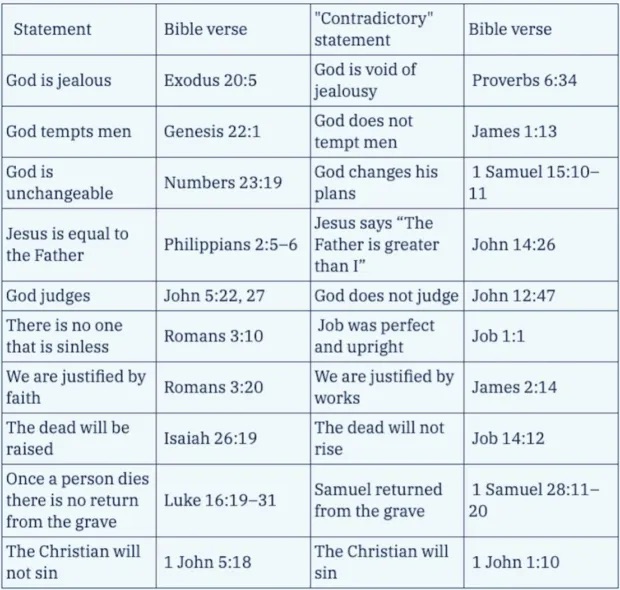
What we must understand is that scripture was written not to contradict, but to provide a different angle on the events. We also would be wise to look at the audience, the author and the purpose of the specific passage. All of these elements come into play with Biblical Interpretation.
However, the one I want to draw focus to and the one that I hear most often is found in Matthew 27:3-9 and Acts 1:15-19. Both of these passages describe the circumstances around the death of Judas. So, how did Judas die? Let us turn to scripture?
Then Judas, his betrayer, seeing that Jesus had been condemned, was full of remorse and returned the thirty pieces of silver to the chief priests and elders.“I have sinned by betraying innocent blood,” he said. “What’s that to us? ” they said. “See to it yourself! ” So he threw the silver into the temple and departed. Then he went and hanged himself. The chief priests took the silver and said, “It’s not permitted to put it into the temple treasury, since it is blood money.” They conferred together and bought the potter’s field with it as a burial place for foreigners. Therefore that field has been called “Field of Blood ” to this day. (Matthew 27:3-8, HCSB)
At this time Peter stood up among the brothers and sisters (a group of about 120 people was there together), and said, “Brothers, the Scripture had to be fulfilled, which the Holy Spirit foretold by the mouth of David concerning Judas, who became a guide to those who arrested Jesus. For he was counted among us and received his share in this ministry.” (Now this man acquired a field with the price of his wickedness, and falling headlong, he burst open in the middle and all his intestines gushed out. And it became known to all the residents of Jerusalem; as a result that field was called Hakeldama in their own language, that is, Field of Blood.) (Acts 1:15-19, HCSB)
Below you will see a side by side comparison of events surrounding the death of Judas. You see a major variance in events. Is it possible that this is just a different view and Matthew and Luke are just providing different in sights. Lets take a look and find out.
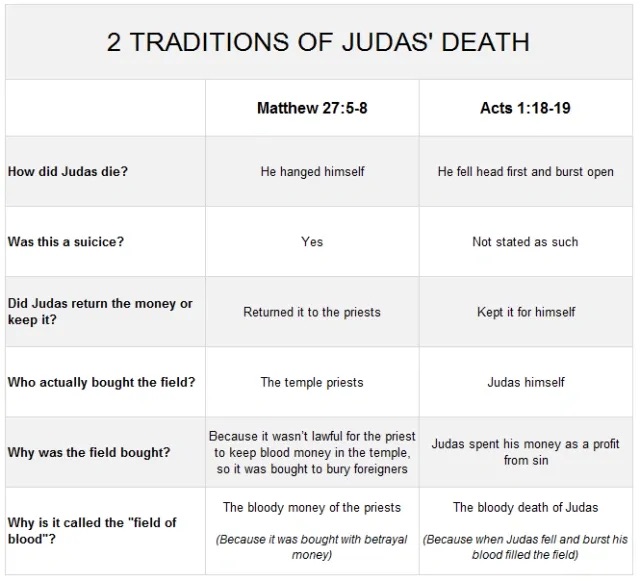
I encourage you to take a few moments and reread these two texts. Make sure this side by side analysis is accurate. Given this brief analysis, the question remains: How did Judas die? Both stories seem straightforward. Both stories agree that Judas dies a tragic death. However, it MIGHT appear that there are fundamental differences. Matthew tells us about Judas’ repentance; Luke does not mention repentance or regret. Matthew says the chief priest bought the field, Luke says Judas bought the field. Matthew says Judas died by hanging while Luke contends that it was a tragic fall.
So, how did Judas die?
Are these two different ideas on his death, which would result in scripture having fault or do we combine Matthew and Luke’s description on the tragic death of Judas. The answer is yes, these two passages combine in perfect harmony. So, what we now have is: One of Jesus’ closest friends has committed suicide. Judas hanged himself and died. Later, the noose broke and his body violently fell headfirst, spilling his guts out on the ground.
Why did the noose break though? Many opponents of this theory will say he hung himself on a weak limb and that would have been a “grave omission by Matthew and Luke”. However, to better understand why the limb broke, we have to dig a little deeper into the events surrounding the death of Judas.
Not many hours after Judas hung himself outside of Jerusalem, Jesus died on Calvary’s Cross. They died in the same general area. Let’s take a look at Matthew 27:50-51.
And Jesus cried out again with a loud voice, and gave up His spirit. And behold, the veil of the temple was torn in two from top to bottom; and the earth shook and the rocks were split.
This earthquake occurred at Christ’s death. It was a seismic event that rocked Jerusalem and the surrounding area, the intense shaking caused Judas’ body to fall from its hanging position. If this quake could tear the temple, it was also strong enough to throw Judas’ body with such force; resulting in his abdomen bursting open.
There is no contradiction in the death of Judas. Yes, there are maybe some questions that are left unanswered. However, scripture is full of those questions and that is why we are to believe by faith.
People will argue that these two passages are a result of scribal error or a fallible Bible. They are simply wrong, these are two passages describing one event.
There are passage like this one with Judas found throughout the New Testament: Creation or even The Birth Narratives. However, remember that we can stack the gospels on top of each other and use all of the details from each passage to paint a clear and perfect picture of what happened
Scripture is in fact the infallible!
My final point is on the Word of God. Is the Bible the Word of God or is it the “word of God”. Notice the difference in capitalization. I think the answer to this is found in John 1:1,14. Now, I understand that my thoughts here may not be aligned with many in the Southern Baptist Church. However we see in this passage that the “Word was God”.
In the beginning was the Word, and the Word was with God, and the Word was God.. and the Word became flesh and lived among Us.”
John paints us a clear picture that the Word of God is God. I understand that to mean that Jesus is the
“Word of God” and the Bible is the “word of God”. I believe that there is considerable differences in the written word of God and the incarnate Word of God. The written word of God – did not and does not have the power to save. The Bible alone will not get you into heaven. If the Bible could get you into heaven, there would have been no point to Jesus’ birth. Salvation comes to us through the son, by our faith in Him. There is a difference between the Bible and Jesus.
Another contribution to my belief in this is the idea that all scripture is equally inspired. In the “early church”, the Old Testament was the word of God.
Every verse to them was not equal. To them the Torah, was considered to have a higher level of importance and inspiration than the other books of the Old Testament. In the first century, Jewish Worship began with that of most importance and moved to that of lesser. It began with the Torah (Genesis, Exodus, Leviticus, Numbers, Deut), History (Joshua – Esther), Wisdom (Job – Song of Songs), Prophets (remainder of OT). For the early Christians Worship was in an ascending order. They would gather and read from the Torah, then the Psalms were often sung, prophets, letters from Paul and then the Gospels.
Early believers did not believe that scripture was of equal importance. We see an example of this in our church today, in a tradition that dates back to the earliest believers. Most of the time during worship we sit and did they in the early church. However, when the Gospels were read they would stand and that is because the Gospels were the very words of Jesus. When Jesus speaks we stand at attention.
For the early believers what Jesus said was more important than what Paul said. What Paul said was more important than what the prophets said. What the prophets said was more important than what the Wisdom writers said. And what the wisdom writers said was more important than what Moses said. 1
So, if this is true and scripture is not equal – where did this idea come from? We first see it come from the nineteenth century Rationalism.
Fundamentalism is primarily rooted in Rationalism
– not the Bible. Under this influence biblical scholars adopted the rational argument that if the Bible was the “Word of God”, then all verses are of equal importance. To put this into a better perspective, Dr. Ron Crawford, uses an illustration from Song of Solomon and compares it to the Book of John. Look at it this way! Solomon is a love letter; filled with images that would be considered erotic of that day. There is no coherent story in the book.
Typically, the church claims it as metaphorical – as is reasoning to be included in the biblical canon.
This idea states that among Jews, the Song of Solomon shows God’s love for the Israelites, with whom he made a sacred covenant. Among Christians, it is believed to show the love of Christ for the Church.
Another idea is that this book, holds no religious implications and is nothing more than secular love poems. Do I believe this to be the case? No, I do not!
However, what I do believe is that this Book in Scripture does not compare to the words: “For God loved the world in this way:He gave His One and Only Son, so that everyone who believes in Him will not perish but have eternal life.” (John 3:16, HCSB).
The Bible is inspired by God! It is a document that God has preserved for the Church, to better understand God, salvation and Christian Theology.
When we open up the Bible, we are hearing from God and the people who experienced God in a way that we have not. The pages come to life as we read from each of the authors in these sixty-six books and the result is worship. We would be foolish not to heed the words found in The Bible. It is truly our road map for living.
 Dr. Jonathan Crawford Blog
Leave a comment